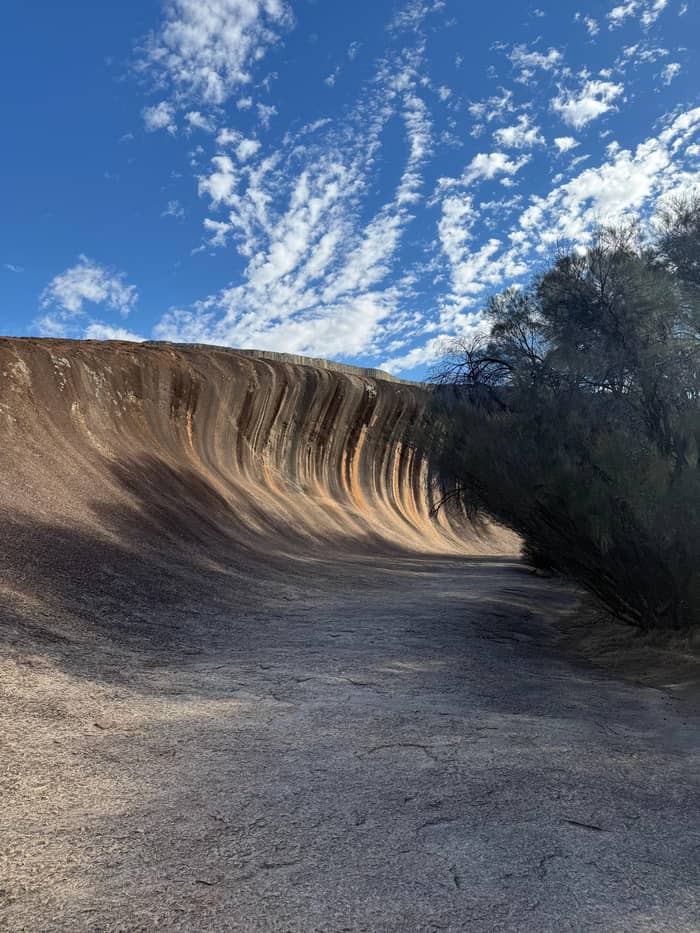
The overhang
Wave Rock
North face of Hyden Rock
- Height15 m
- Length110 m
- Look forStripes
Help me decide
Two questions, one granite day
Say where you are starting and how you like to travel, and a Wave Rock trip appears with its starting price.
Your match
from $188
12.5 hours with pickup and an English-speaking guide, taking in York, Hippo's Yawn, Wave Rock and Mulka's Cave.
Your match
from $77
2 hours from the Wave Rock Car Park, with hand stencils and Dreaming stories of Katter Kich.
Your match
from $715
A private group half day of 5 hours: a flight from Jandakot, then a guide drives you to Wave Rock.
Your match
from $455
A private group day of 11 hours with pickup, stopping in York, Corrigin and Kondinin on the way.
The Wave Rock formation looks like a breaker frozen in stone, but it was shaped slowly from below, by water working on ancient granite. This is the geology made plain, with the figures and where each comes from.
Editorial team, waverocktour.com · Updated November 8, 2026 · ~8 min read
Main facts
The Wave Rock formation is not a separate boulder but the edge of a much larger rock. The Australian Museum describes it as a curved granite cliff face that is really the northern face of a big erosional remnant called Hyden Rock.1 The Shire of Kondinin's trail brochure says the same in plainer words: the wave is the famous feature, while the whole outcrop carries the name Hyden Rock.6 Stand back in the car park and you can see the dome rising behind the curl.
Its size is modest on paper and enormous in person. The Museum gives 15 m of height and 110 m of length for the curved face.3 The Shire's brochure translates the height into something easier to picture: more than 100 metres in length, and at 15 metres higher than a 3-storey building.7 What the figures miss is the lean of the wall. The upper part hangs out over your head, and that overhang is what turns a granite slope into a wave.
Different official pages round the length differently, which confuses some visitors. Tourism Western Australia and the Museum both say 110 metres, while the Shire's attraction page settles on about 100 metres of length and about 15 metres of height.8,9 Wave Rock Management says more than 100 metres.10 None of these contradict each other: the curve has no sharp start or end, so where you begin measuring decides the number, and the chart further down sets them side by side.
Fact sheet
| Fact | Figure | Source |
|---|---|---|
| Height | 15 m | Australian Museum3 |
| Length | 110 m | Australian Museum3 |
| Age of the granite | about 2700 million years | Australian Museum2 |
| Shaping began | as much as 60 million years ago | Shire brochure11 |
| Visitors to Hyden | more than 100,000 a year | Shire of Kondinin17 |
| Town water from the rock | until 2000 | Shire brochure18 |
Each figure is quoted as its official source gives it.3,11,17,18
If you are wondering what type of rock is Wave Rock, the answer is granite, the hard, speckled rock that forms deep underground from cooling molten material. Wave Rock Management describes the face as multicoloured granite about to crash onto the bush below.10 Up close you can see the crystals in the stone, and in the shade at the foot of the wall the surface feels cool even on a hot afternoon. On the drive east you pass other granite domes poking through the farmland, cousins of the same stone.
As for its age, the Australian Museum puts it at about 2700 million years.2 The Shire of Kondinin gives about 2.7 billion years and ranks it among the oldest rock on the planet.14 Wave Rock Management phrases it as more than 2,700 million years in the making.15 Whichever way it is written, the number refers to the age of the granite itself, the time since that rock formed far below the surface.
That is a different question from the age of the wave shape, and this is where many explanations go wrong. The Shire's brochure says the wave probably started to take shape below ground, up to 60 million years ago.11 So the stone is ancient almost beyond imagining, while the curve carved into it is young by comparison. Keeping the two numbers apart is the key to understanding everything else about the formation.
The question of how was Wave Rock formed has a short answer from the Australian Museum: weathering and water erosion rounded the cliff, undercutting its base and leaving a rounded overhang.4 Tourism Western Australia describes the shape the same way, as the work of weathering and water erosion.8 There was no sea here and no breaking wave of water; the name describes what the rock looks like, not how it was made.
The Shire's brochure adds the detail that matters: the shaping is believed to have started underground.11 Picture the base of the outcrop buried in soil that stayed damp for long periods. Where moisture sat against the granite, the rock slowly rotted into grit, while the parts above stayed dry and hard. Over a very long time a hollow formed along the buried foot of the wall. Later, as the land around was worn lower, the soil was carried away and the hollow came out into the open as the curve you see today.
Wind and rain still play a part at the surface. Australia's Golden Outback writes of wind and rainwater erosion carving the 110-metre-long break.16 Today, though, the change is far too slow to see in a lifetime. What you are looking at is essentially a frozen record of a long underground process, now exposed.
Three granite shapes
The overhang
North face of Hyden Rock
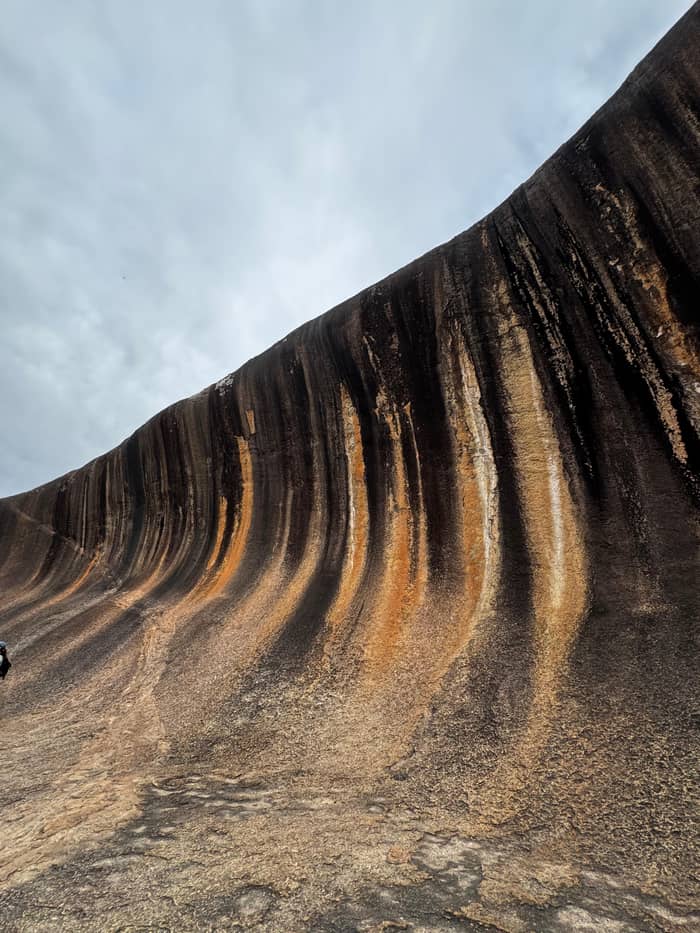
The mouth
A granite tor
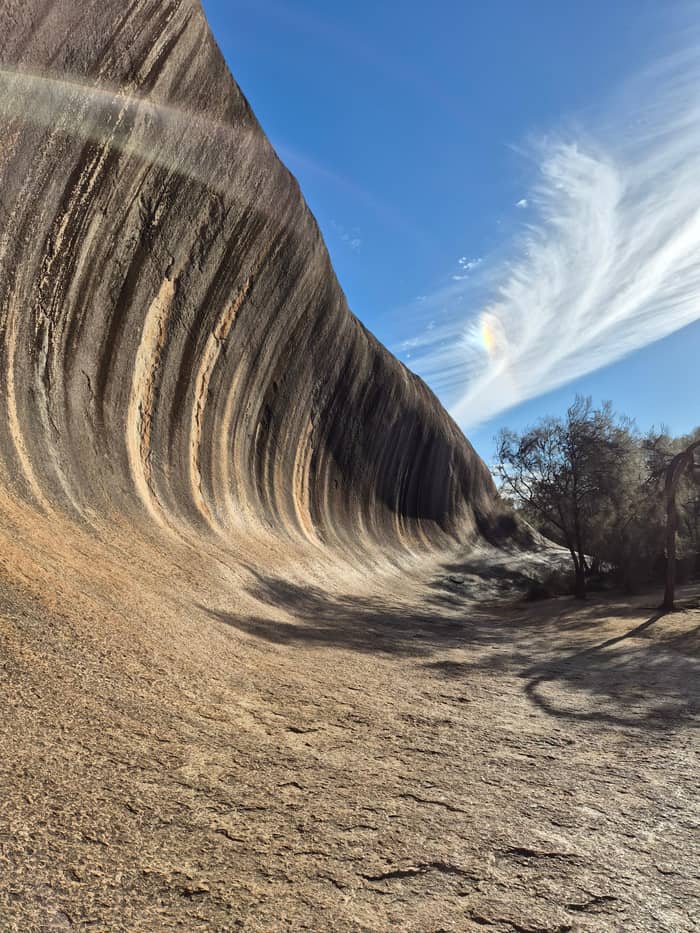
The summit
Outcrop to the north
The colours on the face are not painted and not mineral layers inside the granite. The Australian Museum explains that in the wetter months, spring water trickles down the face, dissolving chemicals in the granite and laying them down again.5 What it leaves behind are stains of carbonates and iron hydroxide in red, brown, yellow and grey.5 Each stripe follows the path that water takes down the curve.
That is why the stripes run vertically while the wave curls horizontally. Water follows gravity straight down the face, and every wet season adds another thin coat where it flows. In bright midday sun the colours can look washed out; in low light early or late in the day the reds and yellows deepen, and the grey bands read more clearly against them. If you want the stripes at their strongest, plan your photos for the softer light.
Please leave the surface as you find it. Wave Rock Management's guidance for bushwalkers is to take nothing away, not even a pebble, and to leave the bush undisturbed.25 The stains are a thin skin on the granite, and they took far longer to build than any visit lasts. Resting a hand on the wall is a good way to feel the scale of it, but scratching names or chipping pieces damages something that cannot be repaired.
Deep time to now
The granite
The granite is about 2700 million years old.2
Underground
Forming began underground as much as 60 million years ago.11
Exposure
Weathering and water undercut the base.4
Wet seasons
Spring water leaves carbonate and iron stains.5
The 1920s
A sandalwood cutter gave the rock and town a name.12
1963/64
A photo of the wave won a Kodak prize in New York.13
Hyden Rock holds more shapes than the wave. Hippo's Yawn, a stroll of approx 1 km around the outcrop, is a granite tor that was once joined to the main outcrop.26,27 Australia's Golden Outback says you can climb through its throat, and it got its name from the way it looks like a yawning hippo.22 Its open mouth is another hollow in granite, smaller and rounder than the curve at the wave, and well worth comparing with it.
On top of granite outcrops like this you will also find gnamma holes. These are hollows worn into hard rock, granite above all, that fill with runoff after rain and work as natural tanks, in Wave Rock Management's description.28 Aboriginal people covered their narrow openings with sticks, leaves and flat rocks to keep animals out and slow evaporation.29 They are a reminder that this geology was also a water supply for people over a very long time.
The rock has served Hyden in a similar way. The Shire's brochure says the Hyden Dam, up on the outcrop, supplied a large share of the town's water until 2000.18 Rain falling on bare granite runs off fast and clean, which made the dome a natural catchment for a farming town in dry country. Walking the loops on top, you get a feel for how much water a rock this size could shed in a winter storm.
Video
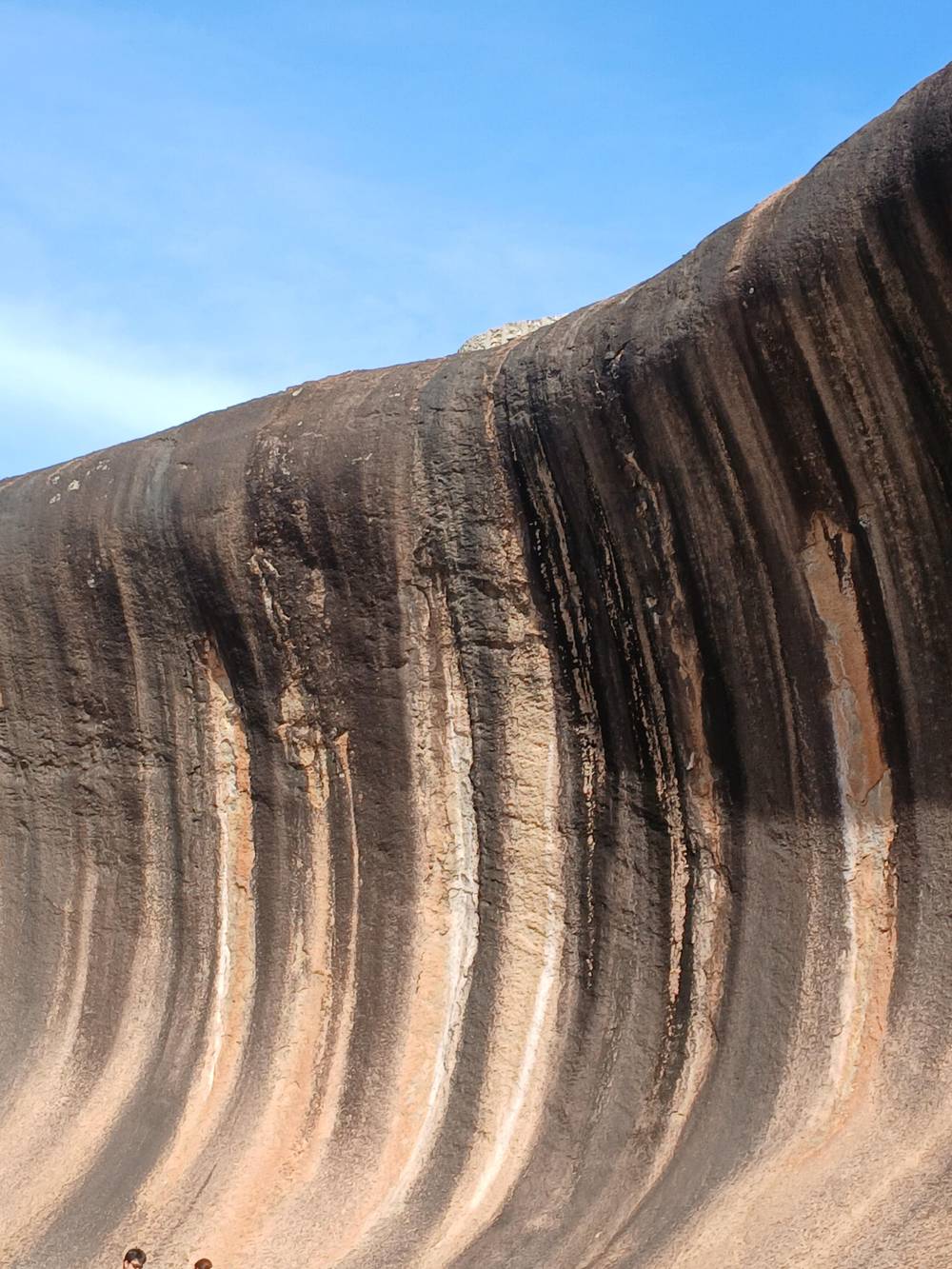
OzGeology on YouTube · The video waits until you tap play to load.
Water from springs active in the wetter months runs down the cliff face, dissolving and re-depositing chemicals in the granite, leaving red, brown, yellow and grey stains of carbonates and iron hydroxide
Reading the rock
For a long time the wave was a local landmark rather than a national one. The Shire's brochure says the outcrop and the town both take their name from a young sandalwood cutter who pitched camp at Hippo's Yawn in the 1920s.12 The earliest recorded farming in the district dates from 1922, with wheat following in 1927.30 For the families clearing the land around it, the outcrop was part of daily life long before anyone drove out from the city to look at it.
Fame came through a photograph. The brochure records that the wave became a national attraction after a photo of it took the prize in Kodak's international colour picture competition of 1963/64, judged at the New York fair.13 A single colour picture, seen far from Australia, turned a farm-district curiosity into a trip people planned for. Hyden's own street sculptures, made from old machinery and scrap metal, carry the town's story through to the arrival of tourists in the 1970s.31
Today, by the Shire's count, more than 100,000 tourists come to Hyden each year for Wave Rock and the granite outcrops around it.17 Some of them come on long day tours from Perth: the site tour on this page runs 12.5 hours and visits Hippo's Yawn, Wave Rock and Mulka's Cave in a single day. It is a long ride for a rock, but standing under the curl makes clear why a single photo was enough to put it on the map.
The rock is its own best textbook if you walk it with the right map. The Wave Rock Walk follows the base of the curve for 325 metres each way, and the Shire's brochure says it has shaded stone seats and interpretation about how the wave formed.19,24 It is flat and easy, which makes it the natural place to start, and you can study the stripes and the overhang up close the whole way, with the curve rising above your head.
For more geology, climb onto the dome. The Hyden Rock Walk offers a shorter and a longer circuit across the dome, 860 metres or 1300 metres in all, both well marked and signed with notes on the rock and its formations.20,32 The brochure also mentions 3 further trails that explore the rock from a scientific angle, with their own guidebook sold at the Wave Rock Visitor Centre.21 They need confident map reading, since the rock face carries markers only at the points of interest.33
Out at the Humps, the Kalari Trail climbs steadily to the summit over 1,670 metres, and its interpretive signs focus on the geology and the plants growing on the rock.34,23 Taken together, these walks turn a quick photo stop into a slow lesson in how granite landscapes are carved, from the overhang at the car park to the summit views out over the salt lakes and paddocks. Bring the Wave Rock facts on this page with you, and check each one against the stone itself.
FAQ
Granite: the wave is the curved north side of Hyden Rock.1
The Museum gives 15 m high and 110 m long.3
Water running down in the wetter months leaves stains of carbonates and iron hydroxide.5
A photo of the wave took Kodak's international colour picture prize, judged at the New York fair.13
Its shorter circuit is 860 metres and its longer 1300 metres.20
Sources
Planning the long day out to Wave Rock? A real person answers here.